Wenglor P1XD101 Fiber-optic amplifier
Fiber-optic amplifier.

$316.00
Part Number
- P1XD101
Highlights...
- P1XD101
- By Wenglor
- FREE Shipping on orders of $2,000 or more
Overview
Features
- Tool-free assembly
- Intuitive setup using display
- NFC communication via the weCon app and IO-Link
- LED red light
- Switching Hysteresis: < 15 %
- Light Source: Red Light
- Wavelength: 633 nm
- Service Life (T = 77°F): > 100,000 h
- Max. Ambient Light: 10,000 Lux
- Supply Voltage: 10 to 30 V DC
- Supply Voltage with IO-Link: 18 to 30 V DC
- Current Consumption (Ub = 24 V): < 40 mA
- Switching Frequency: 7 kHz
- Response Time: 71 µs
- On-/Off-Delay: 0 to 10,000 ms
- Temperature Drift: < 10 %
- Temperature Range: -13°F to 140°F
- Switching Output Voltage Drop: < 2 V
- Switching Output/Switching Current: 100 mA
- Short Circuit Protection: yes
- Reverse Polarity Protection: yes
- Overload Protection: yes
- Teach Mode: NT, MT, MT with dynamic readjustment, jump detection, DT, BT, WT
- IO-Link transmission speed: COM3
- Interface: IO-Link V1.1.3
- Protection Class: III
- Setting Method: NFC, Display
- Housing Material: Plastic, ABS, Plastic, PC, Plastic, PA
- Degree of Protection: IP50
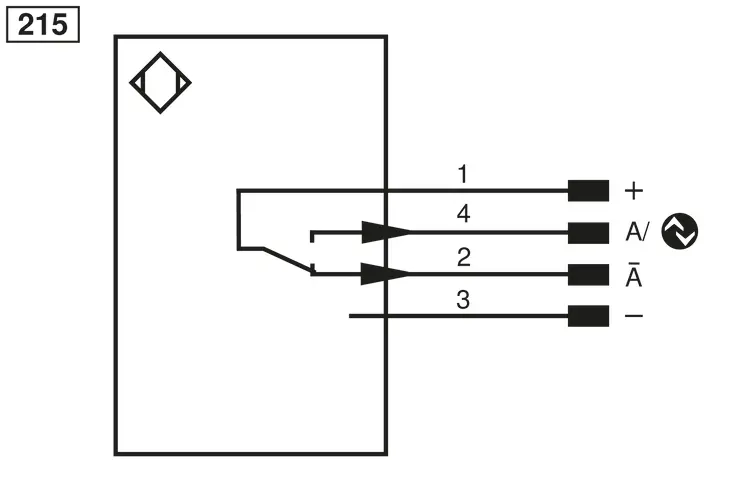
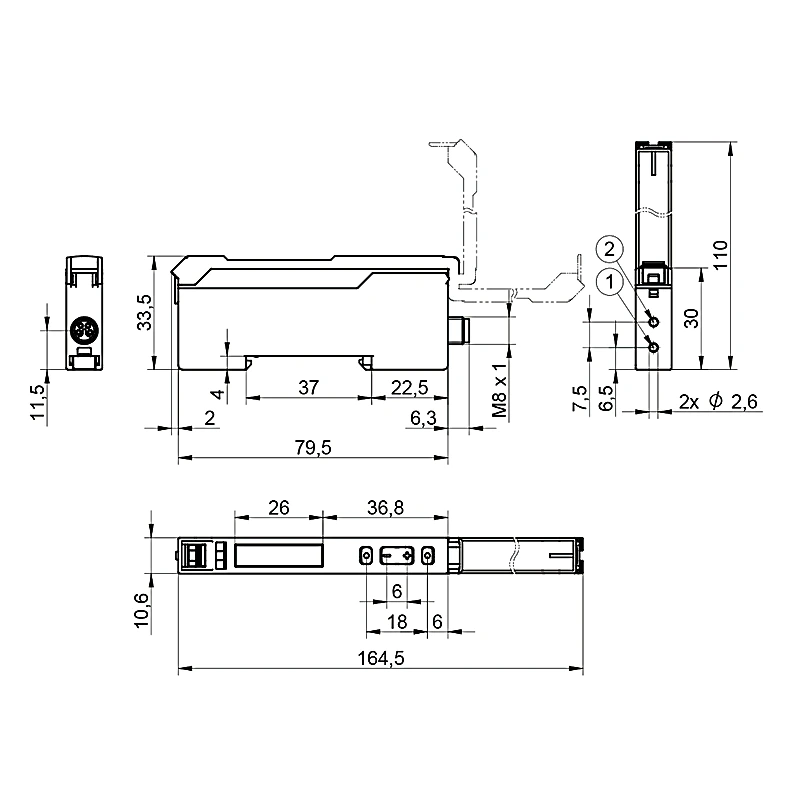
- Connection: M8 × 1; 4-pin
- DIN-Rail mounting: 35 mm
- Weight: 35 g
- MTTFd (EN ISO 13849-1): 640.47 a
- Scope of delivery: 1 × initial start-up instructions, 1 × sensor
- IO-Link: yes
- PNP NC, PNP NO: yes
- Output: Push-pull, NPN, PNP
- Circuit: inactive, Error output, NC, NC+NO, NO
- Other parameters: 2 switching points, Off-delay, On-delay, Dynamic readjustment, Error indicator, Error output, Filter, Hysteresis, Switching point, Emitted light, Sensor localization, Adjustable sensor mode, Teach mode
- Complementary Products: Plastic Fiber-Optic Cable, IO-Link Master
Description
Fiber-optic sensors work according to the energetic principle in which light is emitted via one fiber-optic cable and received via another. The amplifier can be adapted to a wide range of application requirements through the use of flexible plastic fiber-optic cables or glass fiber-optic cables with adapter no. 7. The display shows both the switching threshold and the currently received signal, which means that the sensor can be set up intuitively and quickly using the buttons. More complex parameterizations can be conveniently carried out via the wenglor weCon app on a mobile device or via IO-Link. All sensor information is also provided via the IO-Link process data. Both the fiber-optic cable and the amplifier can be mounted without tools, which further simplifies handling.
Documents
Spec Sheets
Other
Need Help? Call an engineer at 1-802-880-3123
We're open 8:00 am to 5:30 pm ET